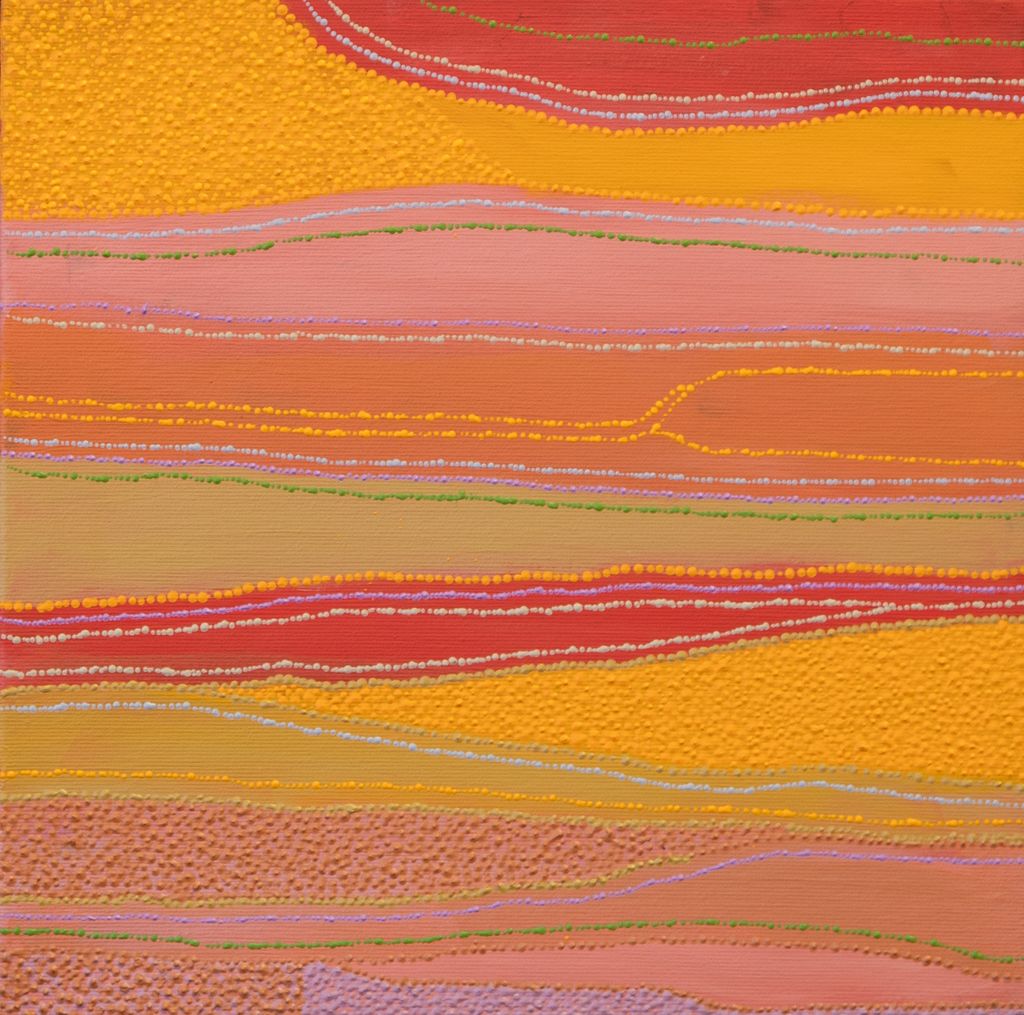
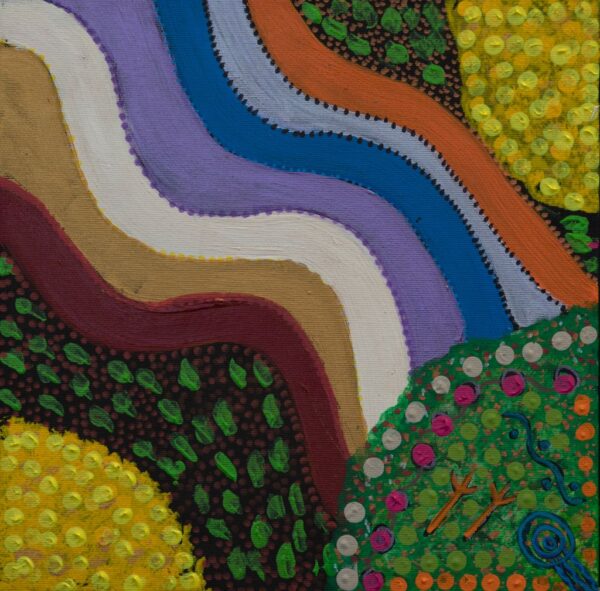
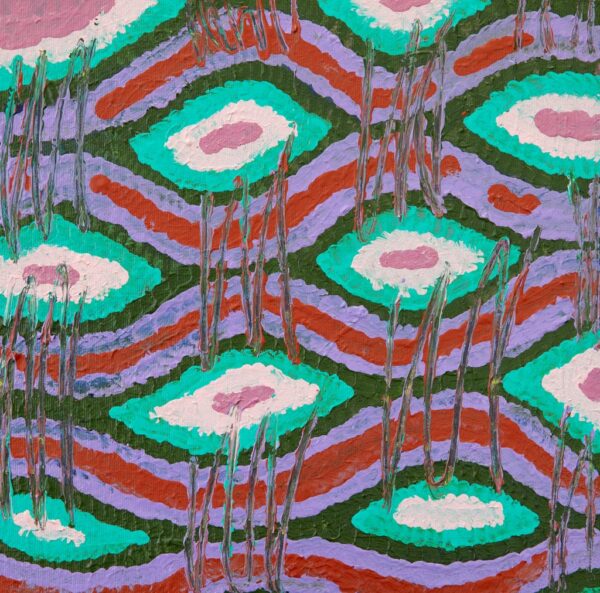
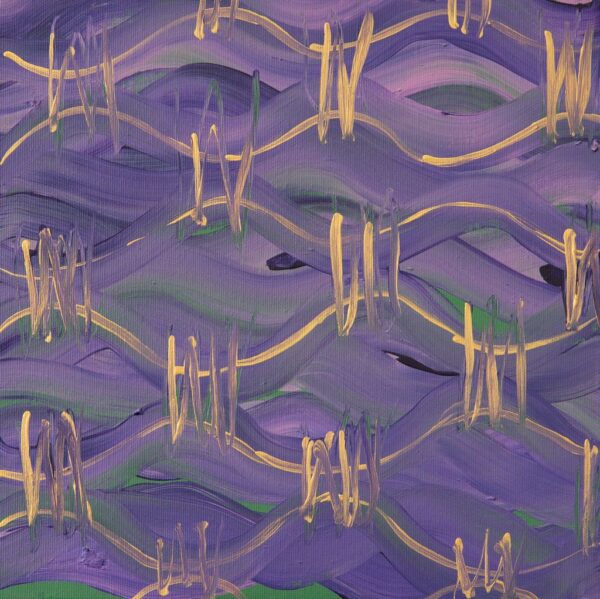
Nuriah Jadai Acrylic on Canvas 30 x 30 cm Year: 2026 26-210
Kulyakartu
“Kulyakartu is where my Taylor family come from. It is my mother’s maternal side, my mother’s mother country. My grandmother Nyunkunyal (Angelina) Taylor was born there. My Nana grew up there up until she was about 8 or 10 years old. My Nana and her sister Managabayi got mixed up with another tribe then ended up living with the Mangala and Juwaliny people, they are neighbours of the Yulparrija (Ngangatjarra) people. Painting Kulyakartu brings back memories of my grandmother and her sisters, Managabayi, Mida and Tuulul. I learnt through going out with KJ (Kanyirninpa Jukurrpa) Rangers that this area is fertile country. Many wild flowers and bush tucker back in the day. Fewer wildflowers than before my grandmother Nola told me, because the land is getting more warmer. It is important to paint country to tell our children where we come from and our obligation to look after it”
– Nuriah Jadai
The Martu term for family, walytja, encapsulates a broader idea of relatedness that permeates every aspect of life. The Martu four-section kinship system determines a person as belonging to either the Purungu, Milangka, Panaka or Karrimarra skin group, and was created by the Jukurrpa (Dreaming) ancestors.
Walytja groups had rights to their ngurra (home Country, camp) as inherited over generations. Also passed down over generations was the intimate knowledge of the physical and cultural properties of one’s Country, and the responsibility to care for and nurture one’s ngurra. The passing of rights and responsibilities through walytja in relation to specific lands continues today.
This painting depicts Kulyakartu, part of Nuriah’s ngurra (home Country, camp). Kulyakartu is located in the far north of the Martu homelands, near the Percival Lakes region of Western Australia’s Great Sandy Desert. Kulyakartu is mostly grass Country where there is very good hunting. In particular parnajarrpa (goanna), wild cats, and lunki (witchetty grub) are found in abundance here. There is no permanent water source in Kulyakartu, so Nuriah’s family would walk here annually following the wantajarra (wet season). During the yalijarra (hot, dry season) they would head south again to more permanent water.
Martumili Artists warns visitors that our website includes images and artworks of Artists who have passed away which may cause distress to some Indigenous people.
Martumili Artists acknowledges the Nyiyaparli and Martu people as the Traditional Owners of the land we live and work on. We also acknowledge the Traditional Owners throughout our country and our Elders; past, present and emerging.