Clifton Girgiba
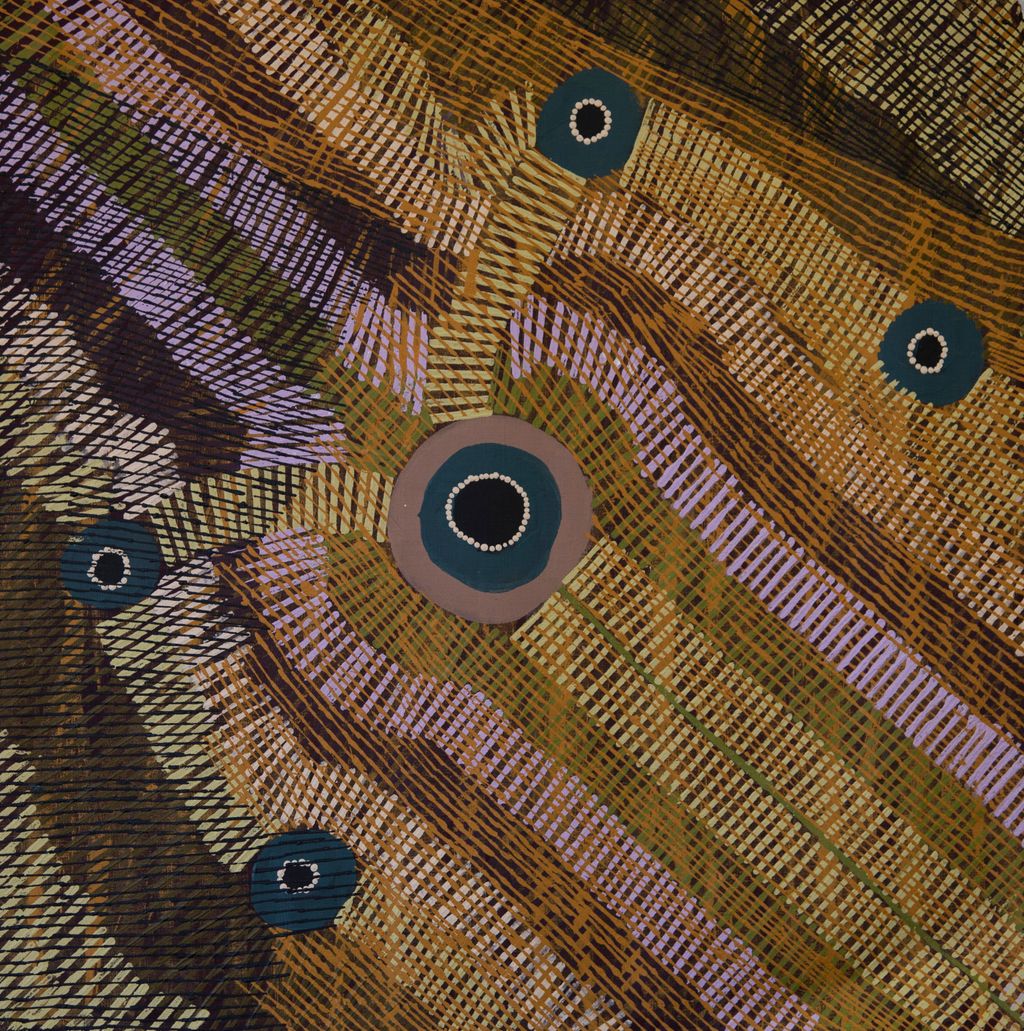
Acrylic on Linen
91 x 91 cm
Year: 2026
26-281
Wuukurra
“This is the boundary for Wuukurra people- my grandmother Kumpaya (Girgirba). It’s also the boundary for Kingu people. This is Pila, Rirrla, Well 30 (Juntu-juntu, Canning Stock Route Well 30) and Well 37 (Lipuru, Libral Well, Canning Stock Route Well 37). South of Kunawarritji ”
– Clifton Girgiba
Juntu-juntu (Canning Stock Route Well 30) is a waterhole located between the Karlamilyi (Rudall River) region and Kunawarritji Aboriginal Community, on the northern section of the Canning Stock Route. Kakarra (east) of Juntu-juntu are Warla-warla and Yaturti waterholes.
Prevalent in the area surrounding Juntu-juntu are jawirli (quondong) trees, providing one of the few bush fruits that comprised part of the pujiman (traditional, desert dwelling) diet. High in vitamin C, the fruit can be eaten raw or cooked, and was also prepared as a treatment for skin ailments due to its antibacterial properties.
Lipuru (Libral Well, Canning Stock Route Well 37) is located northeast of Kunawarritji Aboriginal community. The site features in the Minyipuru (Jakulyukulyu, Seven Sisters) Jukurrpa (Dreaming). The Minyipuru rested here during their travels along the sandhills in this region.
Minyipuru is a central Jukurrpa narrative for Martu, Ngaanyatjarra, Pitjantjatjara and Yankunytjatjara people that is associated with the seasonal Pleiades star constellation. Beginning in Roebourne on the west coast of Western Australia, the story morphs in its movement eastward across the land, following a group of women as they walk, dance, and even fly from waterhole to waterhole. As they travelled the women left markers in the landscape and create landforms that remain to this day. During the entirety of their journey the women are pursued by a lustful old man, Yurla, although interactions with other animals, groups of men, and spirit beings are also chronicled in the narrative. The Minyipuru flew to Lipuru from Pangkapirni, between Canning Stock Route Wells 35 and 36, where Yurla grabbed one of the women and forcibly slept with her. Though she was eventually freed by her sisters, Yurla again caught up to them and tried to grab them at Lipuru.
In colonial times, Lipuru gained notoriety for the many deaths that occurred at the site following the establishment of the Canning Stock Route. The first of these occurred in 1911, when three drovers, were attacked near Lipuru. A series of retributional murders against several Martu families and then other drovers and surveyors ensued. Following these murders, the route was barely used again for nearly twenty years.
The intersection of the Canning Stock Route with Juntu-juntu also made this a site of early contact with Europeans for many Martu then living a pujiman life in the desert. Following the route’s construction, Martu encountered Europeans and other Martu working as cattle drovers as they would travel up and down the Stock Route from water source to water source. Increasingly, pujimanpa (desert dwellers) followed the route to newly established ration depots, mission and pastoral stations. They were drawn to the route in search of food, by a sense of curiosity, or by loneliness. By the late 1950s and early 1960s, most of the desert family groups had left the desert. Eventually, these factors combined with an extreme and prolonged drought in the 1960s to prompt the few remaining pujimanpa to move in from the desert.