Damien Miller
Acrylic on Canvas
76 x 122 cm
Year: 2025
25-980
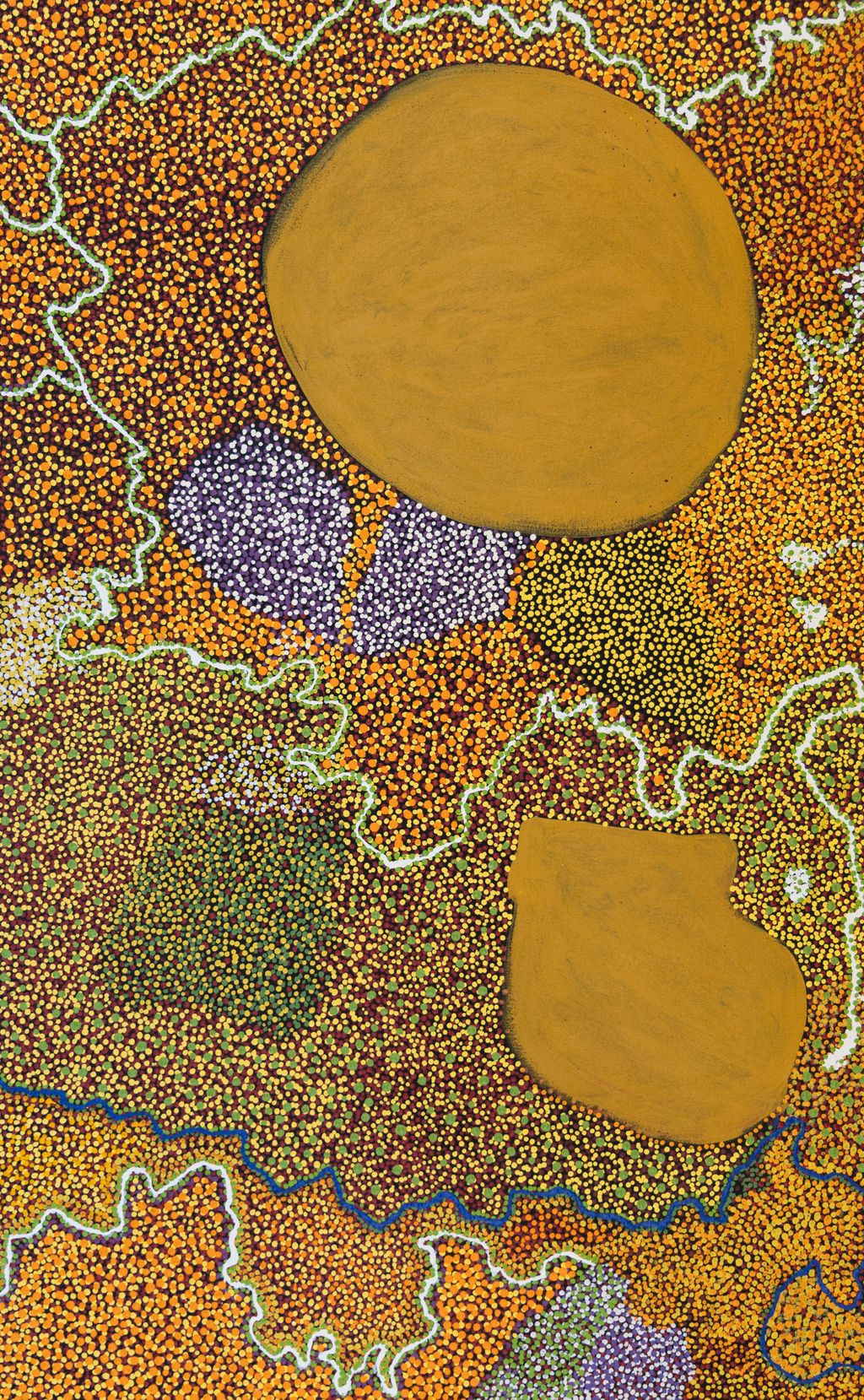
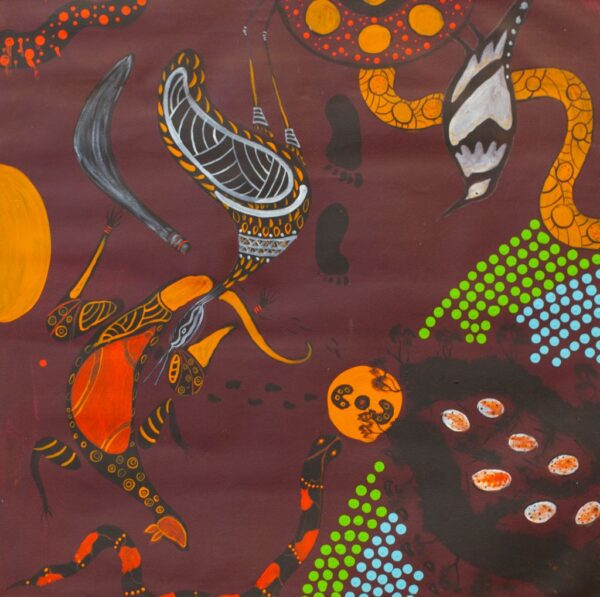
Paji to Pirrkili
Paji is a soak and hill located east of Nyayartakujarra (Lake Dora). Paji features as an important site in Jila Kujarra (Two Snakes) one of the key Jukurrpa (Dreaming) narratives for the Martu. Though the story belongs to Warnman people, it is shared across the Western Desert with several other language groups. The narrative centres on the travels of two snakes as they are pursued by the Niminjarra, spiritual ancestors of the Warnman people.
The Jila Kujarra were chased by the Niminjarra to Paji. The Niminjarra believed the snakes had hidden in a cave north of Paji, and tried to smoke them out. Here the Jila Kujarra eluded their pursuers by escaping under the lake at Paji and at the same time creating many small decoy snakes to lead the Niminjarra astray. Meanwhile, from a nearby hill, two Pukurti (initiates with bundled hair) prophesied that the Niminjarra would kill the Jila Kujarra. The Pukurti tracked the Jila Kujarra through to Nyayartakujarra, where they speared the snakes in the head to hold them down while they returned to Paji to summon the Niminjarra. The Niminjarra made a fire and cooked the snakes at the site of Kumpupirntily (Kumpupintily, Lake Disappointment), but when the Niminjarra cut down the length of the Jila Kujarra, the snake’s bladders were pierced, causing an explosion of scalding hot urine in which the Niminjarra all perished and became black rocks at the site. At the same time, the urine of the Jila Kujarra formed the vast salt lake, Kumpupirntily, which translates to ‘bladder burst’. The spirits of the Jila Kujarra rose and continued to travel to their mother at Nyayartakujarra, where they remain to this day.
Pirrkili is a rockhole surrounded in all directions by permanent tali (sandhills), located east of Nyayartakujarra (Lake Dora) and south of Punmu Aboriginal community. Linyji (claypans) such as Pirrkili were traditionally visited more often during the wantajarra (wet season) when they were filled with water.
This site lies within Nyanjilpayi’s ngurra (home Country, camp) through her uncle and grandmother, and forms part of the area which she knew intimately and travelled extensively in her youth. The Western Desert term ‘ngurra’ is hugely versatile in application. Broadly denoting birthplace and belonging, ngurra can refer to a body of water, a camp site, a large area of Country, or even a modern house. People identify with their ngurra in terms of specific rights and responsibilities, and the possession of intimate knowledge of the physical and cultural properties of one’s Country. This knowledge is traditionally passed intergenerationally through family connections. Painting ngurra, and in so doing sharing the Jukurrpa (Dreaming) stories and physical characteristics of that place, has today become an important means of cultural maintenance. Physical maintenance of one’s ngurra, like cultural maintenance, ensures a site’s wellbeing, and is a responsibility of the people belonging to that area.